This web page is the point of public access to spatial data infrastructure (SDI) of the Group of Ecotoxicology of the University of Vigo, in the public information that is related to the pollution developed and compiled by the group, mainly in the coasts of Galicia, although not exclusively. The information is available for your visualization, query, and download via the web or using any GIS desktop.
The available data will grow as you go by incorporating new information to the databases of the group.
See and interact with data published by the group in a viewer via the web on the orthophoto PNOA (2007-2008), the OpenStreetMap layer or Google image Satellite.
- Access the metadata catalog based in Geonetwork to search for the information published by the group.
- Add external mapping services (WMS) of other administrations or producers of digital mapping.
- Access to group data through GIS software through WMS and WFS standards.
- Download the digital mapping in various vector formats (GML, KML and Shapefile).
Map Viewer
The cartographic viewer provides information about the chemical quality status of the Galician coastal water (mainly), based on chemical pollutants and ecotoxicity bioassays data. The data comes from two sources: literature and unpublished data collected by the group.
The chemical quality status is represented by a traffic light color code, similar to the one used by the OSPAR Commission in its Quality Status Report, for what they propose as cut-off points to separate the different environmental states as a function of concentrations or response metrics. It has been used three boundary values or cutoff points (P1, P2 and P3) which leads to four ecological states: background, acceptable, uncertain and unacceptable.
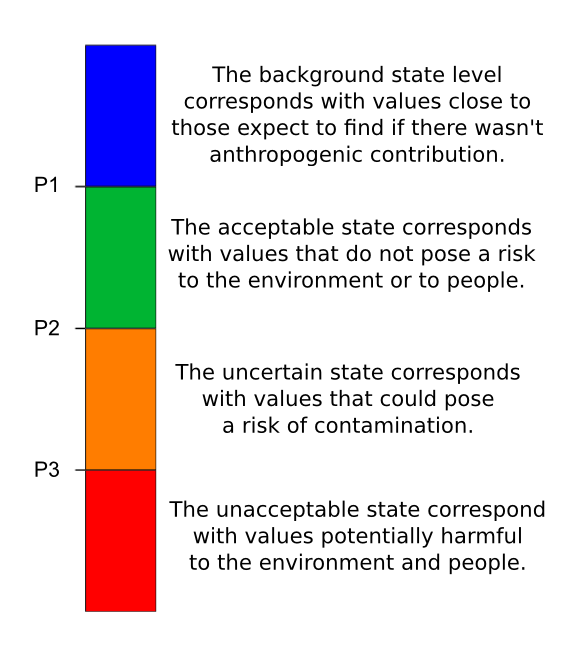
The cutoff points are established taking into account the criteria of the OSPAR Commission and scientific studies widely accepted by the scientific community and supranational organizations, selecting the most appropriate for each type of chemical contaminant and for each ecotoxicological response.
Chemical pollution data currently available is: concentrations of metals and polycyclic aromatic hydrocarbons (PAHs) in sediments (cutoff points in table 1 and table 2) and wild mussels (cutoff points table 4 and table 5), and ecotoxicity bioassays (PNR values) using sea-urchin larvae exposed to water and elutriates (aqueous extraction of the sediment) (cutoff points in table 3).
Data is grouped in five-year periods, given the stability of the sediment, yielding three study periods: 1997-2001, 2002-2006 and 2007-2011, selecting the worst state for the same station when more than one value is available.
| *Value normalized to 5% Aluminium | ||||
| Metales | P1 | P2 | P3 | |
|---|---|---|---|---|
| BAC (1) | ERL (2) | SQCM(3) | ERM (4) | |
| Cadmio (Cd) | 0.129 | 1.2 | 9.6 | |
| Cobre (Cu) | 27* | 34 | 270 | |
| Plomo (Pb) | 22.4 | 58.7 | 218 | |
| Mercurio (Hg) | 0.091 | 0.15 | 0.71 | |
| Zinc (Zn) | 122* | 150 | 410 | |
| HAPs | P1 | ​P2 | ​P3 |
|---|---|---|---|
| BAC | TEL (5) | PEL (6) | |
| Fenantreno (Phe) | 7.3 | 86.2 | 544 |
| Antraceno (Ant) | 1.8 | 46.69 | 245 |
| Fluoranteno (Fla) | 14.4 | 113 | 1494 |
| Pireno (Pyr) | 11.3 | 153 | 1398 |
| Benzo (a) Antraceno (BaA) | 7.1 | 74.8 | 693 |
| Benzo (a) Pireno (BaP) | 8.2 | 88.8 | 763 |
| Bioensayo | P1 | P2 | P3 |
|---|---|---|---|
| EAC0(7) | EAC1 (7) | EAC2 (7) | |
| Erizo de mar | 0.879 | 0.694 | 0.508 |
| Metais | P1 | P2 | P3 |
|---|---|---|---|
| BAC | MEDIUM(8) | HIGH(9) | |
| Cadmio (Cd) | 0.96 | 4 | 10 |
| Cobre (Cu) | 6 | 17 | 40 |
| Chumbo(Pb) | 1.3 | 4 | 7 |
| Mercurio (Hg) | 0.09 | 0.18 | 0.36 |
| HAPs | P1 | P2 | ​P3 | ||
|---|---|---|---|---|---|
| BC(10) | CCAC(11) | BAC | EUR(12) | EAC(13) | |
| Fenanthrene (Phe) | 4 | – | 11 | – | 1700 |
| Anthracene (Ant) | – | 0.44 | 2.7 | – | 290 |
| Benzo (a) Anthracene (BaA) | 1.0 | – | 2.5 | – | 80 |
| Benzo (a) Pirene (BaP) | 0.5 | – | 1.4 | 25 | – |
References
- Álvarez-Iglesias, P., Rubio, B. & Pérez-Arlucea, M. (2006). Reliability of subtidal sediments as “geochemical recorders” of pollution input: San Simón Bay (Ría de Vigo, NW Spain). Estuarine, Coastal and Shelf Science, 70(3), 507–521.
- Albentosa, M., Viñas, L., Besada, V., Franco, A., & González-Quijano, A. (2012). First measurements of the scope for growth (SFG) in mussels from a large scale survey in the North-Atlantic Spanish coast. The Science of the Total Environment, 435-436, 430–45.
- Barciela-Alonso, M. C., Pazos-Capeáns, P., Regueira-Miguens, M. E., Bermejo-Barrera, A. & Bermejo-Barrera, P. (2004). Study of cadmium, lead and tin distribution in surface marine sediment samples from Ria de Arousa (NW of Spain). Analytica Chimica Acta, 524(1-2 SPEC. ISS.), 115–120.
- Beiras, R., Bellas, J., Fernández, N., Lorenzo, J. I. & Cobelo-Garcia, A. (2003). Assessment of coastal marine pollution in Galicia (NW Iberian Peninsula); Metal concentrations in seawater, sediments and mussels (Mytilus galloprovincialis) versus embryo- larval bioassays using Paracentrotus lividus and Ciona intestinalis. Marine Environmental Research, 56(4), 531–553.
- Beiras, R., Fernández, N., Bellas, J., Besada, V., González-Quijano, A. & Nunes, T. (2003a). Integrative assessment of marine pollution in Galician estuaries using sediment chemistry, mussel bioaccumulation, and embryo-larval toxicity bioassays. Chemosphere, 52, 1209–1224.
- Beiras, R., Tato, T., Laranjeiro, F., Durán, I. & Mendoza, M. (2010). Informe de seguemento biolóxico da contaminación para a implementación dun monitoring integrado da costa Atlántica española. Campaña CONQUIBIOS 2010 (Galicia-Cantábrico), pp. 1-18.
- Beiras, R., Trigo, N. S., Tato, T. V. (2011). Informe preliminar de resultados del proyecto DRACORE, pp. 1-12.
- Beiras, R., Tato, T. V. & Ramos, J. (2012). III Informe preliminar de resultados proyecto INNODRAVAL. Ecotoxicidad de las muetras del Puerto de Marín, 13 pp.
- Bellas, J., Fernández, N., Lorenzo, I. & Beiras, R. (2008). Integrative assessment of coastal pollution in a Ría coastal system (Galicia, NW Spain): Correspondence between sediment chemistry and toxicity. Chemosphere, 72, 826–835.
- Bellas, J., Nieto Ó, & Beiras, R. (2011). Integrative Assessment of Coastal Pollution: Development and Evaluation of Sediment Quality Criteria from Chemical Contamination and Ecotoxicological Data. Continental Shelf Research 31(5): 448–56.
- Bellas, J., Albentosa, M., Vidal-Liñán, L., Besada, V., Franco, M. Á., Fumega, J., González-Quijano Á., Viñas l, Beiras, R. (2014). Combined use of chemical, biochemical and physiological variables in mussels for the assessment of marine pollution along the N-NW Spanish coast. Marine Environmental Research, 96, 105–17.
- Besada, V., Fumega, J. & Vaamonde, A. (2002). Temporal trends of Cd, Cu, Hg, Pb and Zn in mussel (Mytilus galloprovincialis) from the Spanish North-Atlantic coast 1991-1999. The Science of the Total Environment, 288, 239–253.
- Besada, V., Andrade, J. M., Schultze, F., Fumega, J., Cambeiro, B. & González, J. J. (2008). Statistical comparison of trace metal concentrations in wild mussels (Mytilus galloprovincialis) in selected sites of Galicia and Gulf of Biscay (Spain). Journal of Marine Systems, 72, 320–331.
- Besada, V., Andrade, J. M., Schultze, F. & González, J. J. (2011). Monitoring of heavy metals in wild mussels (Mytilus galloprovincialis) from the Spanish North-Atlantic coast. Continental Shelf Research, 31, 457–465.
- Carro, N., Saavedra, Y., García, I., Ignacio, M. & Maneiro, J. (2001). Distribution patterns of polychlorinated biphenyl congeners in marine sediments and wild mussels from Galicia coast (Northwestern Spain). Journal of Shellfish Research, 20, 1215–1221.
- Carro, N., García, I., Ignacio, M. & Mouteira, A. (2002). Levels and distribution patterns of polychlorinated biphenyl congeners in surface sediments from Galicia coast (Northwestern, Spain) according to granulometric characteristics. Environmental Technology, 23, 919–930.
- Carro, N., García, I., Ignacio, M. & Mouteira, A. (2004). Possible influence of lipid content on levels of organochlorine compounds in mussels from Galicia coast (Northwestern, Spain). Spatial and temporal distribution patterns. Environment International, 30, 457–466.
- Carro, N., García, I., Ignacio, M. & Mouteira, A. (2010). Spatial and temporal trends of PCBs (polychlorinated biphenyls) in mussel from Galician coast (1998-2008). Environment International, 36, 873–879.
- Casado-Martínez, M. C., Buceta, J. L., Belzunce, M. J. & Del Valls, T. A. (2006). Using sediment quality guidelines for dredged material management in commercial ports from Spain. Environment International, 32, 388–396.
- Cobelo-García, A. & Prego, R. (2003). Heavy metal sedimentary record in a Galician Ria (NW Spain): Background values and recent contamination. Marine Pollution Bulletin, 46, 1253–1262.